
Written by:
Carles Caballé Llufriu, Project Engineer at Klinea Biotech & Pharma Engineering
The pharmaceutical industry is undergoing a period of transformation, with two seemingly contradictory trends converging and redefining the established paradigms of drug manufacturing. On the one hand, personalised medicine is driving demand for treatments tailored to each patient, requiring highly flexible and adaptable manufacturing processes. On the other hand, the pursuit of operational efficiency is pushing towards standardisation and the application of economies of scale.
The COVID-19 pandemic has intensified this dilemma, demonstrating both the need for agility in responding to health emergencies and the importance of mass production capacity.
It seems logical to think that these two trends are contradictory: greater personalisation leads to lower efficiency, and vice versa. And although this may be true at a macro level, since personalised medicines will always be less efficient to manufacture than those produced on a large scale, it is also clear that there are increasingly more technological solutions that enable personalised manufacturing to be more efficient, as well as solutions that allow for greater flexibility in large-scale production.
The revolution in pharmaceutical personalisation
CAR-T (Chimeric Antigen Receptor T-cell) therapies represent the most extreme paradigm of pharmaceutical personalisation. Each treatment requires the extraction of T lymphocytes from the patient, their ex vivo genetic modification, controlled cell expansion, and personalised reinfusion. This process requires specialised facilities to perform cell manipulation and incubation, maintaining product traceability back to the individual patient.
In this context, robotic systems offer crucial advantages, such as the elimination of human error in critical processes, rapid product/format changeovers, and reproducibility under aseptic conditions. They also facilitate the ability to handle multiple patient batches simultaneously, without the risk of cross-contamination and while maintaining individual traceability. In this way, automation allows production to be scaled up for greater efficiency, without sacrificing flexibility or customised manufacturing.
Another technology with significant advantages in this type of manufacturing is single-use systems, which allow for great flexibility, as well as the elimination of washing and sterilisation processes, enabling a shorter time-to-market.
Standardisation and economies of scale
Standardisation aims to reduce unit costs through high production volumes and process optimisation. Traditional economies of scale are fundamental for high-volume medicines, where production efficiency translates directly into medicine accessibility.
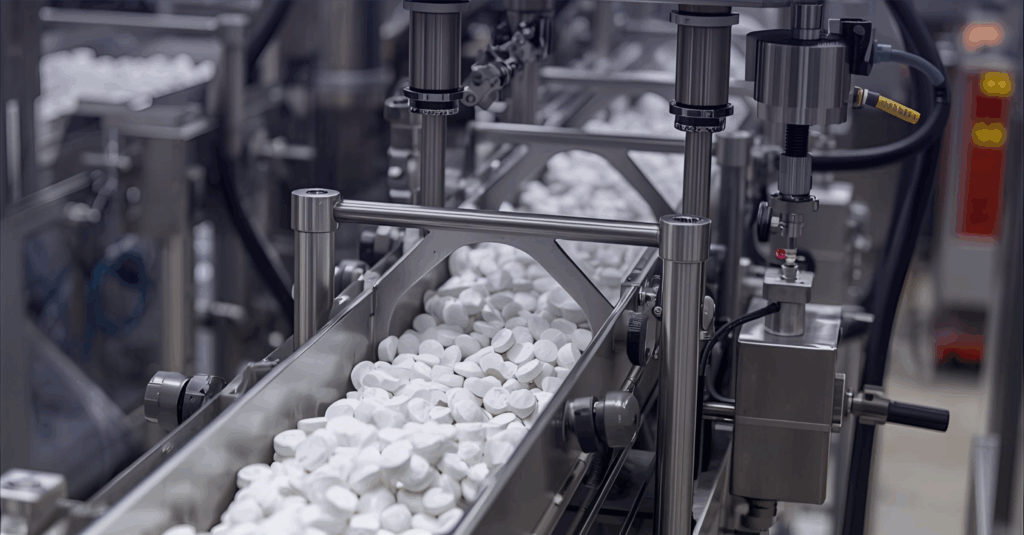
Continuous manufacturing for solid oral forms perfectly exemplifies this trend. Unlike traditional batch processes, continuous systems can integrate mixing, granulation, drying, compression, coating and conditioning into a single, uninterrupted line. The advantages are numerous: reduced processing times, smaller footprint of the facilities, reduced intermediate storage, and elimination of the transfer of bins and IBCs, with the consequent reduction in workplace accidents. The main disadvantage is the difficulty of changing products since, at present, the automated cleaning of these systems can pose a challenge in terms of design, validation and cycle time.
An additional example of economies of scale can be seen in aseptic filling lines for injectables, which reach speeds of over 600 vials per minute and feature optimised integration of inspection and packaging processes. It is true that these high-speed lines rely on traditional stainless steel formulation systems and servomotor-driven movement systems, but the possibility of adopting single-use solutions adapted to the required batch sizes and the use of robotic filling systems, which greatly reduce format changeover time, is not far off.
Large-scale production requires processes with minimal downtime and reliable systems. Predictive maintenance, enabled by IoT sensors and big data analytics, can minimise unplanned downtime by predicting failures before they occur. Machine learning algorithms are capable of analysing vibrational, thermal and acoustic patterns to anticipate maintenance needs, maximising Overall Equipment Effectiveness (OEE).
Meeting points
As we have seen, manufacturing methods for personalised therapies, using technologies such as robotic systems and single-use systems, can achieve ever-increasing efficiency, among other advantages offered by these technologies. High-volume manufacturing methods, on the other hand, can increasingly adopt systems that allow for greater flexibility, as well as achieving ever-greater efficiencies.
Furthermore, a common factor between both manufacturing methods is the advantages of adopting Quality by Design (QbD) methodologies. Process monitoring using Process Analytical Technology (PAT) can enable better process control and reduce the need for final product analysis. In both cases, this offers a significant advantage: on the one hand, in personalised medicine, batch volumes are extremely small, so the product needed for sampling in the laboratory can represent a relatively large amount. On the other hand, in very large batches or continuous manufacturing, having real-time data and trends allows the process to be controlled at all times. As these are long-term processes, this makes it possible to detect variations that might not be captured with traditional sampling methods and to correct them during the process.
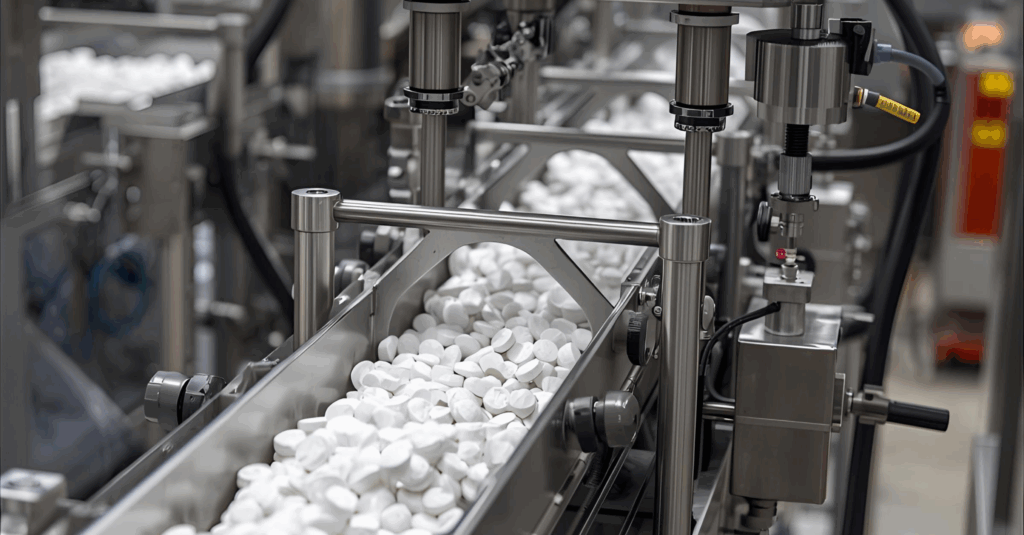
Figure 1. Representation of high-volume production processes
Implementation barriers
Regulatory agencies face the challenge of adapting regulatory frameworks designed for traditional batch processes to continuous or customised paradigms. For example, the implementation of Real Time Release Testing (RTRT) requires demonstrating equivalence with traditional analytical methods, a process that can take years and require significant investment in comparative studies.
On the other hand, integrating advanced technologies into existing facilities presents considerable technical challenges. It can be difficult to integrate PAT systems or robotic technologies into systems that were not designed for them.
Finally, technological changes of this magnitude are unlikely to be successful unless they are accompanied by profound cultural changes within organisations. Training is crucial to ensure that operators have the necessary skills for these new technological paradigms.
Conclusions and future prospects
The pharmaceutical industry faces a fascinating paradox: the tension between personalisation and efficiency is finding innovative technological solutions that reconcile both demands. Robotic automation and single-use systems can make customised manufacturing viable on a larger scale, while continuous manufacturing and predictive maintenance are revolutionising the efficiency of large-scale manufacturing.
The point of convergence lies in cross-cutting technologies such as QbD and PAT, which benefit both personalised medicine and mass production through real-time monitoring and optimised process control.
However, the success of this transformation requires a joint effort by drug manufacturers, regulatory agencies, equipment manufacturers, and engineering and consulting services companies to overcome the challenges posed by these new technologies. The future will be bright for those who know how to overcome obstacles with ingenuity and inventiveness.