
Written by:
Jordi Gibert, Head of the Biotechnology Business Unit at Klinea Biotech and Pharma Engineering
For years, the cosmetics industry has evolved mainly through formulation, marketing and sensory experience. However, in the last decade, a more profound and structural change is taking place: the entry of biotechnology as a source of actives, processes and innovation model. This change not only redefines the cosmetic product, but also the way in which its development, manufacturing and market positioning are conceived.
The cosmetics industry no longer competes solely on the basis of texture or fragrance. It competes on the basis of demonstrable efficacy, traceability, sustainability and scientific complexity, attributes directly linked to the use of biotechnological technologies.
From natural extract to biotechnological active ingredient
Traditionally, many cosmetic ingredients were obtained by relatively simple processes: plant extraction, basic chemical synthesis or physical mixtures. Today, an increasing share of the most innovative active ingredients comes from microbial fermentation, cell culture, protein engineering or biocatalysis.
Functional peptides, recombinant proteins, metabolites produced by microorganisms or cell extracts are no longer exceptions, but common elements in premium dermo-cosmetic ranges. These actives allow greater biological specificity, better reproducibility and, in many cases, a more favorable sustainability profile than classical routes.
This technological leap has a direct impact on the brand discourse, but also on the industrial reality behind the product.
Cosmetics with biotechnological DNA: new rules of the game
Incorporating biotechnology in cosmetics is not just a matter of changing the origin of the ingredient. It means accepting that product development is governed by dynamics closer to biotechnology than to conventional cosmetics.
Development times are longer, processes more sensitive and critical variables more numerous. The consistency of an asset produced by fermentation or cell culture depends on parameters that must be precisely controlled: growth conditions, sterility, process stability and robustness to scale-up.
This forces cosmetic companies to rethink how they integrate biotechnology innovation within their organizations, both technically and strategically.
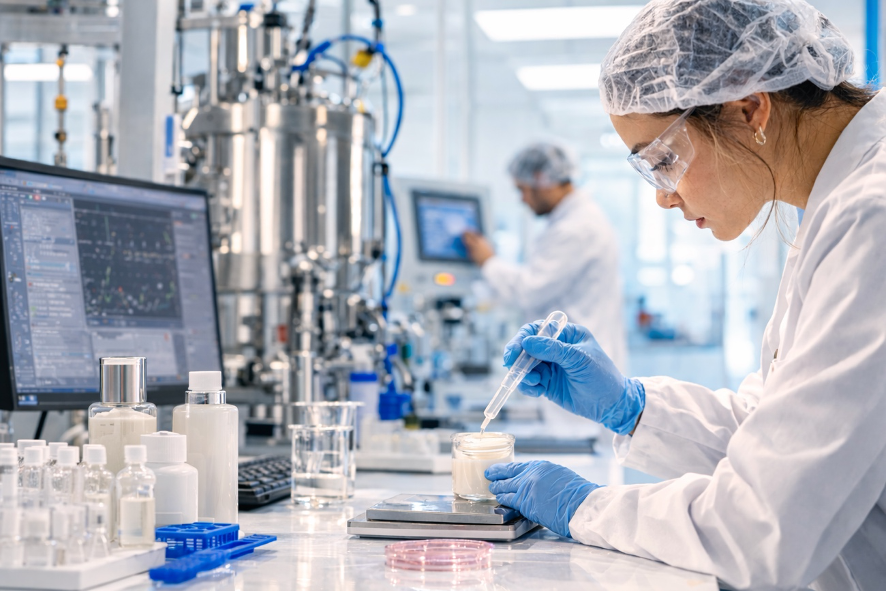
Figure 1. The development of biotechnology-based cosmetic actives requires precise and controlled experimental processes, from laboratory research to future industrial production.
Scaling science: the real challenge
One of the critical points in advanced cosmetics is not to discover a promising active ingredient, but to convert it into an industrially manufacturable ingredient, with controlled costs and constant quality.
Many projects demonstrate efficiency in the laboratory or on a small scale, but encounter difficulties when they have to be produced repeatedly. The lack of an early industrial vision can lead to bottlenecks, reprocessing or inefficient investments.
In this context, collaboration between scientific, technical and industrial profiles is no longer optional. Biotechnology applied to cosmetics requires thinking from the outset about the complete product cycle: from proof of concept to sustained manufacturing over time.
An increasingly blurred boundary between sectors
The convergence between cosmetics, biotechnology and pharmaceuticals is not only conceptual. At the technological level, many tools, knowledge and methodologies are shared, although the regulatory frameworks are different.
This hybridization creates opportunities, but also requires judgment. It is not a matter of “copying” pharmaceutical models, but of adapting biotechnological solutions to the cosmetic context, finding the right balance between technical rigor, agility and economic viability.
The companies that best manage this frontier are those capable of translating scientific complexity into understandable, safe and competitive products.
Sustainable innovation: beyond marketing
Another major driver of biothenology in cosmetics is sustainability. Well-designed fermentation processes can reduce resource consumption, minimize waste and avoid overexploitation of natural raw materials.
However, real sustainability is not only achieved through the origin of the asset, but also through optimized, energy-efficient industrial processes that are designed for the long term. Biotechnology offers powerful tools, but its positive impact depends on how it is implemented on an industrial scale.
Thinking differently to compete better
The cosmetics of the future is being built today, and it is doing so on an increasingly scientific and technological basis. Brands that strategically integrate biotechnology not only gain access to new assets, but also develop a competitive advantage that is difficult to replicate.
This advantage lies not only in the innovation of the ingredient, but also in the ability to understand, produce and evolve that innovation in a consistent manner. In a market saturated with promises, biotechnology, when well applied, allows science to be converted into real value for the consumer.
Because, ultimately, advanced cosmetics is no longer defined only by what it contains, but by how it is created.